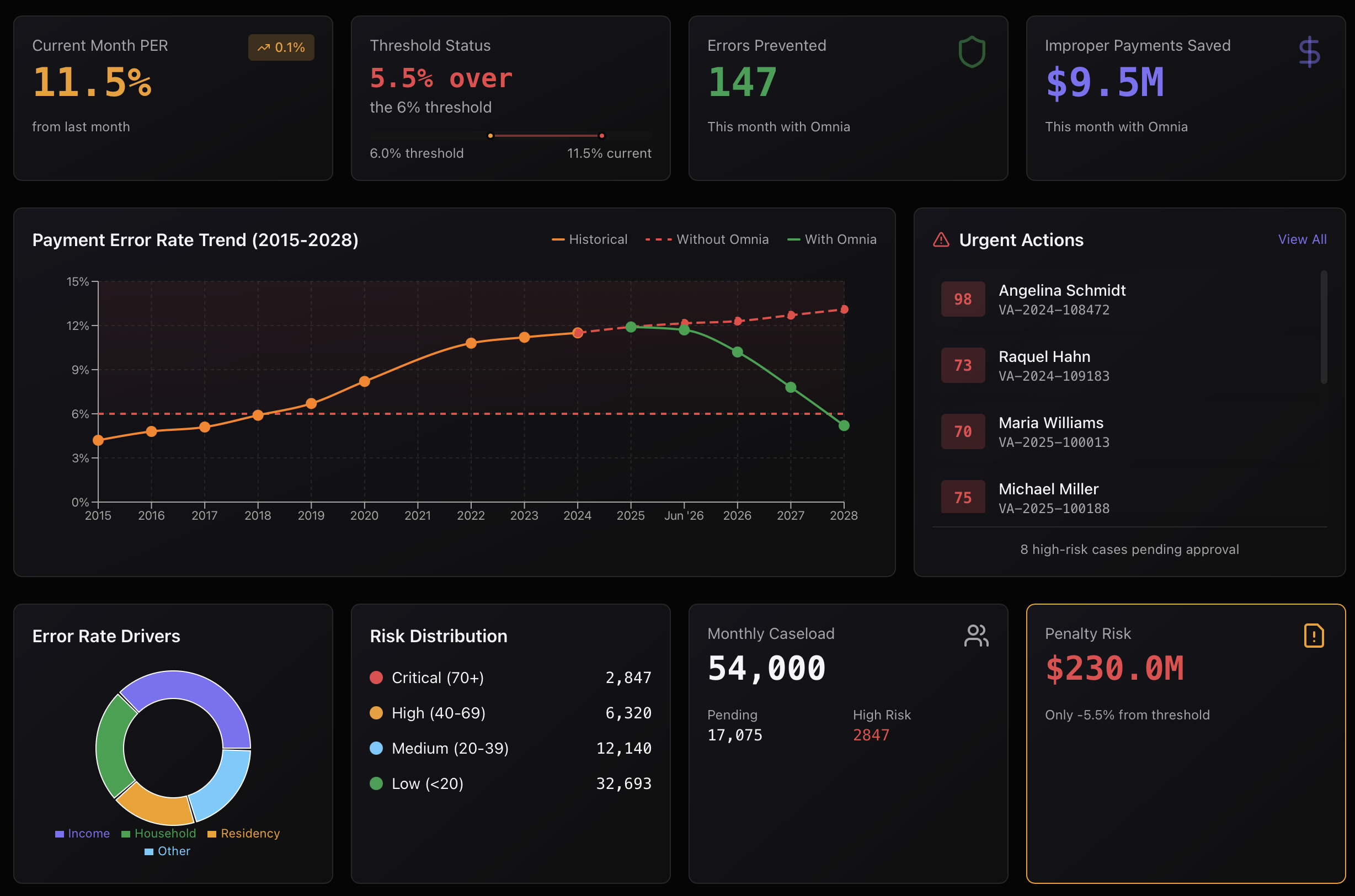
Where Virginia SNAP Payment Errors Actually Start
When SNAP payment error rates rise, attention often jumps straight to the number. But the number is an outcome, not a process.
The process lives inside eligibility workflows where decisions are made under real constraints: time pressure, policy complexity, system limits, and high caseloads.
At the state level, payment error rates are calculated and reported through federal Quality Control. QC reviews assess the accuracy of eligibility and benefit determinations and form the basis for how payment error rates are measured. By the time QC reviews a case, the operational conditions that shaped the decision have already passed.
In states where counties are the primary administrators for SNAP programs, those conditions surface earlier inside local offices. Across states and local agencies, the same operational drivers appear again and again.
For many county leaders, the hardest question is not whether to slow down. It is where to slow down when everything feels urgent. Here are some of the challenges that counties have been facing:
1. Limited real-time income visibility at application
Eligibility staff sometimes must make determinations before income information fully reflects recent changes. This is especially common with irregular earnings, rapid job changes, or incomplete documentation during the initial decision window.
2. Verification rules that increase complexity without prioritization
Stronger verification can improve compliance, but when workflows treat most cases as equal risk, staff time gets spread thin. Higher-risk scenarios do not consistently receive deeper scrutiny than routine cases.
3. Case-by-case processing limits cross-case visibility
Eligibility work happens one case at a time, while many operational risks are pattern-based. Repeat addresses, serial reapplications, recurring changes, and similar scenarios are difficult to spot early without system-level visibility.
4. Limited visibility into post-approval changes
After approval, income and household composition can change. When those changes are not visible in a timely way, benefit amounts can drift away from actual eligibility until the next report, match, or review.
5. Downstream correction work competes with current caseload
When errors are identified after benefits are issued, staff time is pulled into corrections, claims activity, appeals support, and audit response. That work directly competes with current case processing.
6. Workload pressure pushes uniform processing
High volume encourages speed and standardization. When staff cannot easily distinguish higher-risk scenarios from routine ones, one-size-fits-all processing becomes both inefficient and risky.
What actually helps counties improve
Counties improve sustainably when they can:
- Prioritize deeper review for cases most likely to drive errors
- Detect patterns across cases, not just within a single file
- Detect post-approval income and household changes faster
- Surface error risk before final approval
Counties do not need another layer of manual review. They need earlier signals, smarter prioritization, and faster feedback loops that reduce rework.
Where OmniaIntegrity fits
OmniaIntegrity is designed to support that shift by turning existing program data into operational workflow support.
It helps teams:
- See risk while there is still time to prevent incorrect issuance
- Focus staff attention on higher-risk cases instead of spreading effort evenly
- Detect recurring patterns across the caseload, not just within individual files
- Work prioritized alerts through a queue designed for day-to-day use
- Track outcomes so processes can be improved, not just added
The goal is not perfection through more effort. The goal is accuracy through better triage and earlier detection, even under workload pressure.
If you are working to reduce SNAP payment errors while protecting staff capacity, the operational question is simple:
How early can your teams see risk, and how clearly can they prioritize work because of it?
That is where durable improvement starts.
For a case-level evidence analysis rather than this operational perspective, read Virginia's payment-error and cost-share research note. For what statewide sampling can say about local departments, see the locality sampling analysis.